

Should You Actually Be Looking for a New Job?
A pay rise isn't always a career move.
There is a familiar pattern when someone starts thinking about changing jobs.
They look at the salary of their current role, look at what other companies are offering, and start asking whether they could earn more somewhere else.
Salary is obviously important. In fact, it is one of the biggest reasons people consider changing jobs.
But it is only one part of the decision.
A new job can give you a 15% pay rise and still be the wrong career move. Equally, staying in your current position can feel comfortable while quietly limiting your progression, experience and future earning potential.
The more useful question is not simply:
"Can I earn more somewhere else?"
It is:
"Will changing jobs make my career better?"
That means looking at what you are actually gaining from your current role, what you could gain elsewhere and whether the difference is significant enough to justify making a move.
For anyone working in packaging, manufacturing, sales, operations, technical, production or management, these are some of the questions worth asking.
Are you still progressing?
This is probably the biggest question to ask yourself.
Progression does not necessarily mean getting promoted every two years.
It could mean managing a larger team, taking responsibility for bigger customers, becoming involved in new projects, developing technical expertise, taking ownership of a new area of the business or simply becoming significantly better at what you do.
The important thing is whether your career is moving forwards.
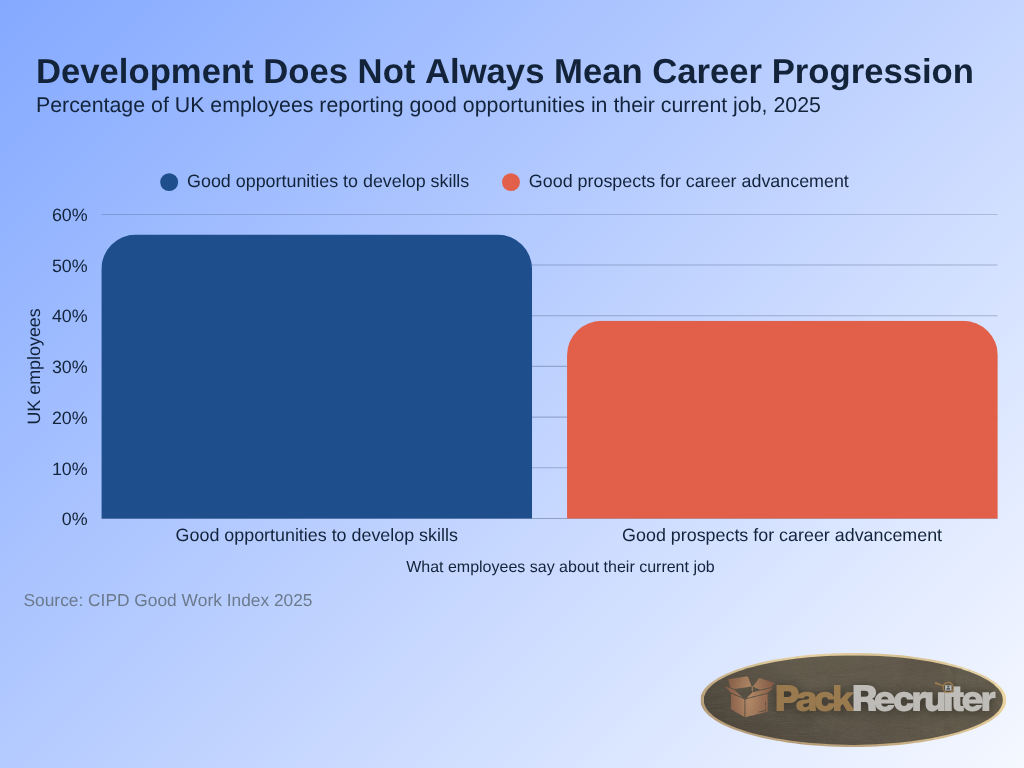
This Graph shows the percentage of UK employees reporting that they have good opportunities in their current job
The distinction shown in the Bar chart above is important. Developing your skills and progressing your career are not necessarily the same thing.
CIPD's research found that 56% of employees said they had good opportunities to develop their skills, but only 39% said they had good prospects for career advancement.
In other words, plenty of people feel they are still learning, but considerably fewer can see a clear path to what comes next.
That is an important question to ask yourself: am I developing, but actually progressing?
The same research found a strong relationship between career progression prospects and employees' intention to leave. Among employees who agreed that they had good prospects for career advancement, 15% said they were likely to quit within the next 12 months. Among those who disagreed, that figure was 27%.
That does not mean a lack of progression automatically causes someone to leave. There are many factors involved.
But it does suggest that being able to see a future within your current organisation matters.
Ask yourself:
Have my responsibilities increased since I joined?
Am I learning new skills?
Am I taking on more complex work?
Have I been given opportunities to progress?
Is there a realistic next step for me?
If I stay for another two years, what will I have gained?
That last question is particularly useful.
Imagine looking at your CV two years from now.
What will be different?
If the answer is "not much", it may be time to have a serious conversation about your career.
Source: CIPD Good Work Index 2025.
Are you being paid fairly, or are you simply being offered more elsewhere?
There is nothing wrong with wanting to earn more.
Pay is a legitimate reason to consider a move, particularly if your responsibilities have increased but your salary has not kept pace.
According to the Office for National Statistics, median gross annual earnings for full-time employees were £39,039 in April 2025, an increase of 4.3% from £37,439 the previous year.
Median weekly earnings for full-time employees increased by 5.3% in nominal terms between April 2024 and April 2025, although real growth after inflation was 1.1%.
But comparing your salary with another job is more complicated than comparing two numbers.
Consider:
£60,000 in a role you enjoy, with strong progression, good management and a growing customer base
versus
£67,000 in a role with little development, a difficult commute, limited support and an uncertain future.
The second job pays £7,000 more.
That does not automatically make it the better career decision.
There are also differences in bonus structures, company cars, pensions, holidays, working patterns, travel requirements, commission, job security and other benefits.
And perhaps most importantly, there is the value of the experience you will gain.
A role paying slightly less today could potentially put you in a much stronger position in three years.
Source: Office for National Statistics, Employee Earnings in the UK 2025.
Consider:
£60,000 in a role you enjoy, with strong progression, good management and a growing customer base
versus
£67,000 in a role with little development, a difficult commute, limited support and an uncertain future.
The second job pays £7,000 more.
That does not automatically make it the better career decision.
There are also differences in bonus structures, company cars, pensions, holidays, working patterns, travel requirements, commission, job security and other benefits.
And perhaps most importantly, there is the value of the experience you will gain.
A role paying slightly less today could potentially put you in a much stronger position in three years.
Source: Office for National Statistics, Employee Earnings in the UK 2025.
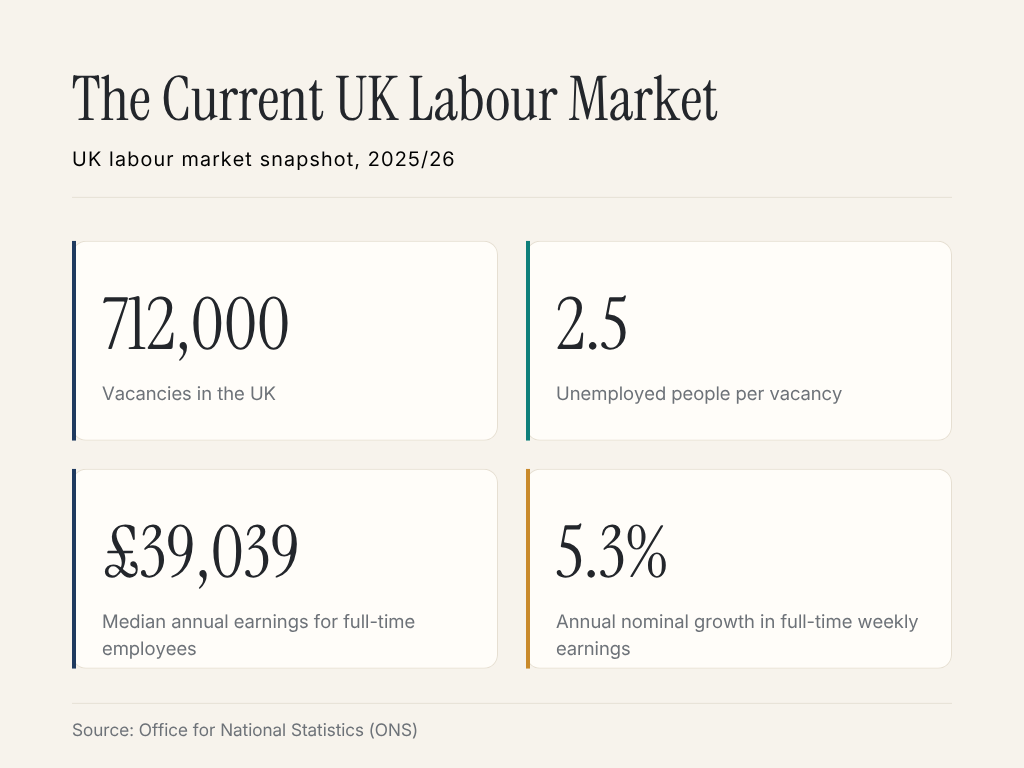
The Current UK Labour Market
The figures give some useful context, but they also show why salary alone isn't enough to judge whether you should move. Earnings are rising, while vacancies and competition in the wider market can affect what opportunities are available.
The question isn't simply whether another employer will pay you more. It's whether the overall opportunity represents a genuine improvement in your career.
Ask yourself:
Is my company investing?
Is my market growing or changing?
Is my role becoming more important to the business?
Am I gaining experience that other employers will value?
Would I still want to be here if the business looked exactly the same in three years?
You do not necessarily need to work for the biggest company.
Sometimes a smaller or growing business can give you considerably more responsibility and exposure than a much larger organisation.
Do you actually like the job?
This sounds obvious, but it is easy to overlook. You spend a huge proportion of your adult life working. A salary increase does not automatically compensate for a role that you dislike.
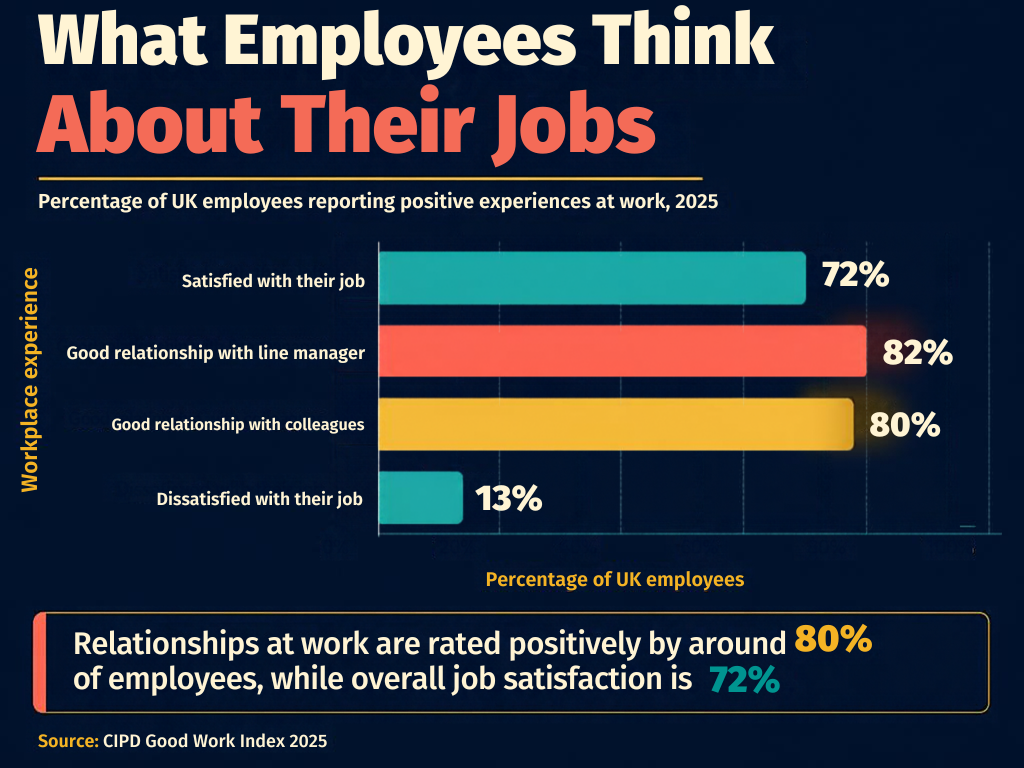
Bar Chart showing the percentages of UK employees reporting positive experiences at work
The figures show an interesting contrast. Most employees report having good relationships with their colleagues and line managers, yet overall job satisfaction is lower at 72%.
That matters when thinking about whether to change jobs. Having a good team and a good relationship with your manager can be a reason to stay, even when other aspects of the job are frustrating. Equally, a job can have good people around you without necessarily offering the progression, development or opportunities you want.
A good working environment is important, but it isn't necessarily the same as having a good long term career opportunity.
The more important question is whether the overall job is working for you.
Do you enjoy the work?
Do you like the people?
Do you have enough autonomy?
Do you feel proud of what you are doing?
Do you feel that your work has a purpose?
Do you look forward to the challenges ahead?
If most of those answers are yes, it is worth thinking carefully before giving that up for a higher salary.
What is your manager actually like?
Your manager can have a huge impact on your experience at work, but it's easy to overlook when thinking about whether to move.
A good manager can give you responsibility, support your development, recognise your work and help you progress. A poor relationship can make an otherwise good role feel very different.
CIPD's 2025 Good Work Index found that 82% of employees rated their relationship with their line manager or supervisor as good.
Before deciding that you need a new job, it's worth asking yourself:
Do you feel trusted by your manager?
Are you given opportunities to develop?
Do you receive useful feedback?
Are your achievements recognised?
Can you have an honest conversation about your career?
Do you understand what you need to do to progress?
Sometimes the problem isn't the job itself. It is the relationship with the person managing you.
And that is worth thinking about before you hand in your notice.
Are you learning anything?
One of the easiest things to underestimate is the value of learning.
A job can become comfortable very quickly.
You know the systems. You know the customers. You know the products. You know how everything works.
That can be a good thing.
But if you have stopped learning, your career can eventually become stagnant.
Think about the last 12 months.
What have you learned that you did not know before?
Have you:
Taken responsibility for larger accounts?
Learned a new manufacturing process?
Managed more people?
Developed technical knowledge?
Entered a new market?
Worked with new customers?
Taken part in a major project?
Learned new technology?
Improved your commercial skills?
If you can point to several examples, staying may still be doing your career a lot of good.
If you struggle to think of one, it may be time to ask why.
Would another company actually make you more marketable?
This is one of the questions people ask too rarely.
Every job should add something to your career.
It might add technical knowledge.
It might add management experience.
It might give you exposure to larger customers.
It might give you responsibility for a bigger budget.
It might teach you how to manage a production site.
It might give you experience in a new packaging format.
It might give you international exposure.
It might give you a track record of winning significant new business.
Over time, these experiences build your market value.
For example, someone who spends five years in sales without growing their responsibilities may have less to show for that time than someone who spends three years progressing from managing a small territory to managing major national accounts.
This is why time served is not the same thing as career progression.
There is no magic number of years that you should stay with an employer.
Three years can be enough to make a significant career move.
Ten years can be perfectly sensible if your responsibilities and achievements have continued to grow.
The question is not:
"How long have I been here?"
It is:
"What have I achieved while I've been here?"
Don't underestimate flexibility and quality of life
Money is only useful if the job still works for the rest of your life.
Commute time, working hours, flexibility and the ability to manage responsibilities outside work can all affect whether a job is sustainable.
CIPD research published in 2025 found that around 1.1 million UK workers had left a job in the previous year because of a lack of flexible working.
That figure represents approximately 3.4% of employees in the survey population.
The research also found that 53% of UK employees said they felt pressure to spend more time in the workplace.
For some people, working from home or having flexible hours is extremely important.
For others, being on site, working closely with colleagues and having face-to-face contact is a major part of what they enjoy.
There is no universal answer.
The important thing is whether the working arrangement fits your circumstances and allows you to perform at your best.
A job that pays more but adds ten hours of commuting every week may not feel like a pay rise for very long.
Source: CIPD, 2025 research into flexible and hybrid working.
Is the problem your job, your company or your career?
This is another useful distinction.
Sometimes people think they need a new employer when what they actually need is a different role.
For example, you might enjoy your company but have outgrown your position.
Or you might enjoy your role but have lost confidence in the direction of the business.
You might like your industry but need more responsibility.
Or you might simply be bored with the type of work you are doing.
Before deciding to leave, identify exactly what you want to change.
Try completing this sentence:
"If I could change three things about my working life, they would be..."
Then ask:
Can my current employer realistically give me those things?
If the answer is yes, there may be a conversation worth having before you start looking elsewhere.
If the answer is no, you have a much clearer idea of what your next move needs to achieve.
The seven questions we would ask before making a move
If you are genuinely considering a new job, take a step back before applying for anything.
Ask yourself:
1. Am I still progressing?
If yes, what does the next step look like?
2. Am I still learning?
What new skills or experience have I gained recently?
3. Is my salary fair for my experience and responsibilities?
Look at the wider market rather than simply comparing yourself with one vacancy.
4. Do I respect the people I work with and for?
Good colleagues and good management have real value.
5. Is the company going in a direction I want to be part of?
Your employer's future can influence your own.
6. Would another job genuinely improve my career?
Don't move simply because another company exists.
7. What will I have gained from the move in three years?
This is perhaps the most important question of all.
When should you actually start looking?
There is no single answer.
If you are learning, progressing, earning fairly, working with good people and have a realistic future where you are, staying may be the best decision.
There is absolutely nothing wrong with being happy in your current job.
But if you have stopped developing, your responsibilities have plateaued, you no longer see a future with the business or you have been thinking about leaving for months without anything changing, it may be worth exploring your options.
And exploring your options does not mean handing in your notice.
You can speak to people in your industry.
You can find out what similar roles are paying.
You can look at what other companies are doing.
You can speak to a recruiter.
You can update your CV.
You can have conversations.
None of those things commits you to leaving.
In fact, sometimes finding out what is happening in the wider market gives you a better understanding of the value of the job you already have.
A new job should solve something
The best reason to change jobs is not simply:
"They are paying me more."
It is:
"This move gives me something my current role cannot."
That might be progression.
It might be greater responsibility.
It might be better management.
It might be exposure to a different market.
It might be technical development.
It might be the opportunity to build something.
It might be a better working environment.
It might be a company with a stronger long-term direction.
And yes, sometimes it will be money.
There is nothing wrong with that.
But before accepting a new job, make sure you understand what you are actually buying with the move.
A career is built over years, not individual pay rises.
The strongest move is not always the one that gives you the biggest increase today.
It is often the one that leaves you in a stronger position tomorrow.
Thinking about your next move?
At Pack Recruiter, we work with businesses and candidates across the packaging, paper and print sectors, from sales and commercial roles through to technical, production, operations and senior management positions.
We speak to people who are actively looking, people who are considering their options and people who are simply interested in understanding what is happening in their market.
You do not need to be desperate to leave your current job to have a conversation.
Sometimes the most useful thing we can do is give you a better understanding of the market, the opportunities available and where your experience could take you next.
If you are considering your next career move, get in touch with Pack Recruiter for a confidential conversation.
Follow Us On Our Socials