

How to Write a CV That Gets Interviews in 2026 | Recruiter Insights
Synopsis - Quick CV Tips That Make a Real Impact
Recruiters spend only seconds on your CV, so it must be instantly clear, relevant and compelling.
Use keywords from the job description to beat systems that filter CVs before a human sees them.
Keep it concise and scannable, ideally one or two pages. Don’t waffle
Bullet points and action verbs highlight impact more effectively than paragraphs.
Use measurable achievements - numbers tell a story recruiters trust.
Avoid clichés and meaningless phrases that add no value.
What you achieved matters far more than what you were tasked with.
Why Your CV Is Your First (and Sometimes Only) Shot
Your CV isn’t just a summary of past roles. It’s a marketing document designed to persuade a recruiter or hiring manager that you’re worth interviewing. In a competitive job market, with hundreds of applicants per role, recruiters make fast decisions. One study showed up to 90% of employers use Applicant Tracking Systems (ATS) to screen applications, and up to 75% of CVs are rejected by these systems before reaching a human reader.
Even after passing ATS filters, recruiters often spend just seconds scanning your CV before deciding whether to read further. That means your CV must be instantly readable, tailored, and targeted. Below we have created our top 10 tips when writing your CV. Our consultants have over 30 years of experience when it comes to reviewing CVs, so we asked them to give us some of their best tips when writing a CV/Resume.
1. Start With a Clear Purpose
A CV should answer a simple question quickly: Why should this person be interviewed?
Focus on three things:
What you were responsible for
What you achieved
How you worked with teams or delivered impact
Avoid long contextual paragraphs - they dilute your strongest points. Think of your CV as a tool to get you the interview, not as the full story of your career.
2. Tailor Every CV for the Role
One of the biggest mistakes job seekers make is sending the same CV to every employer. Many recruiters and ATS systems look for keywords directly from the job advert. If your CV doesn’t include them, it may never be seen.
Actionable tip:
Before writing, highlight the key words in the job description. These are often technical skills, software names, industry terms, and role responsibilities. Reflect them in your CV where they genuinely apply.
3. Keep It Simple, Structured and Scannable
Recruiters and systems alike favour clear formatting. A strong structure helps both ATS and human readers:
Professional Summary
Key Skills / Expertise
Work Experience
Education / Qualifications
Use bullet points, consistent font (10–12 pt) and white space so readers can scan quickly.
Avoid:
Tables, graphics, columns and heavy formatting (ATS can’t read these well)
Novelty fonts or flashy colours
Long paragraphs of text
Think of your CV like a packaging design problem - simplicity and clarity win every time.
4. Focus on Achievements, Not Responsibilities
Just listing duties is a missed opportunity. Results make your CV measurable and memorable.
Good example:
Delivered a 15% reduction in production defects by implementing a new quality audit process across three lines.
Bad example:
Responsible for quality audits.
Use action verbs such as “led, delivered, improved, reduced, expanded,” and whenever possible include quantified impact.
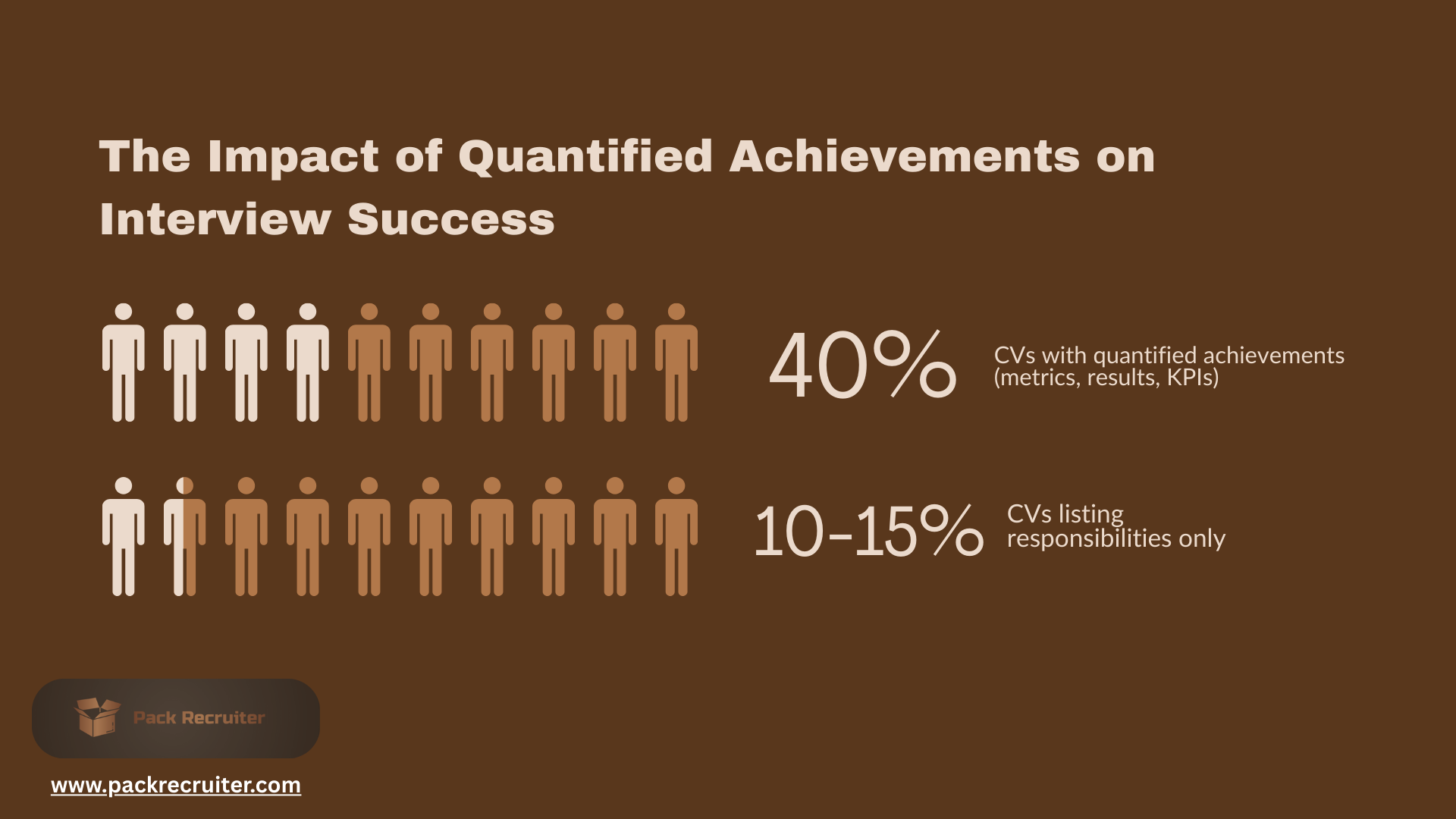
Comparison showing interview success rates for CVs that include measurable achievements versus CVs that focus only on responsibilities.
This comparison highlights a clear difference in interview outcomes based on how a CV is written. Candidates who include quantified achievements such as percentages, revenue figures, volumes, growth metrics or performance improvements are 2-3 times more likely to be invited to interview than those who list responsibilities alone.
Recruiters and hiring managers review large volumes of CVs under time pressure. Numbers immediately provide context, credibility and scale, allowing decision-makers to understand impact at a glance. In contrast, responsibility-based CVs require interpretation, slow down the screening process and often fail to differentiate one candidate from another.
The takeaway is simple: what you achieved matters far more than what you were tasked with. By translating your experience into measurable outcomes, you significantly increase your chances of progressing to interview. CVs that clearly demonstrate impact through numbers reduce ambiguity for the reader and consistently outperform responsibility-led CVs at the interview selection stage.
5. Be ATS-Friendly - Without Losing Human Logic
Modern hiring blends algorithms and people:
Many companies screen candidates using Applicant Tracking Systems (ATS) first.
If your CV lacks keywords or uses non-standard formatting, it may be rejected before a recruiter sees it.
Best practice:
Use standard section headers like Experience, Skills, Education
Avoid excessive styling that breaks parsing
Embed keywords naturally
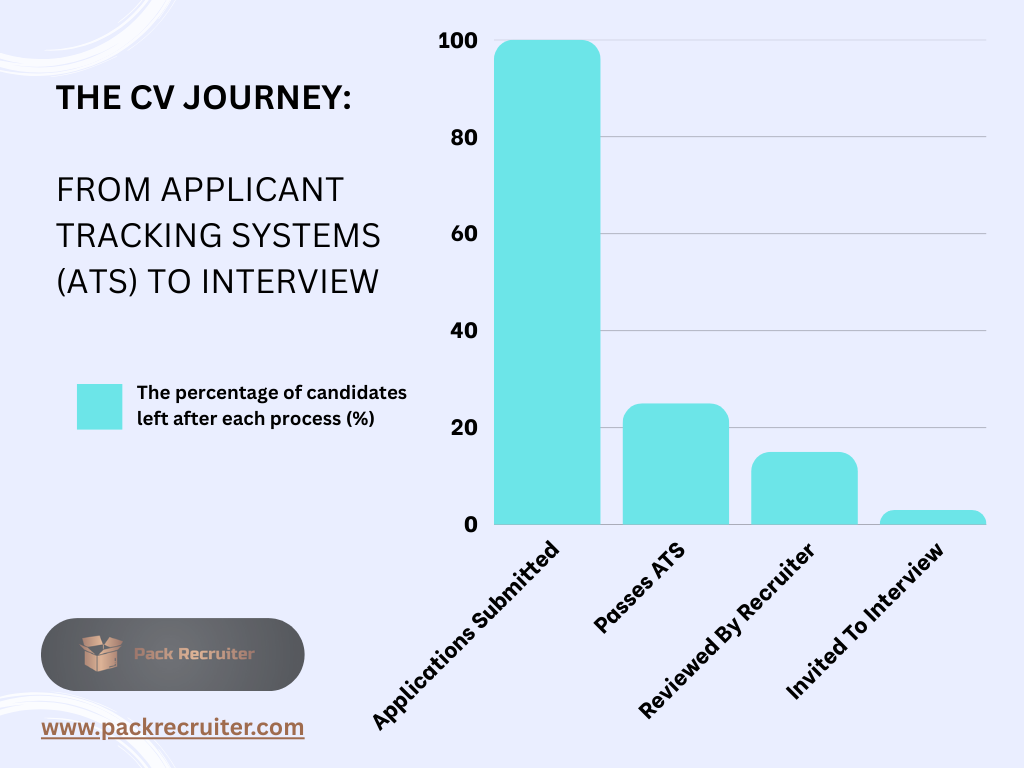
Percentage of candidates invited to interview after submitting a CV
The bar chart above highlights the sharp drop between the number of candidates who submit a CV and those ultimately invited to interview. While applications begin at 100%, typically only around 2-3% progress to the interview stage.
This clearly demonstrates how competitive the initial screening process has become and why keyword alignment within your CV is critical. Recruiters and hiring managers review large volumes of applications every day and are scanning for specific skills, experience, and measurable achievements, many of which are signposted directly in the job description.
The takeaway is simple: focus on the parts of the process you can control. Tailor your CV to each role, use relevant keywords naturally, and ensure your experience and achievements clearly reflect what the employer is looking for.
6. Make It Readable in Seconds
Studies show recruiters spend as little as 6-8 seconds on an initial CV review - and often move on quickly if nothing jumps out.
This reinforces a core principle:
If your top third isn’t compelling, you lose the chance to tell the rest of the story.
Put your best achievements at the top and make your value proposition obvious within the first few lines. Make sure that your experience that is most relevant to the job description and role, “Shouts” loudest, Ideally at the beginning of your CV/Resume.
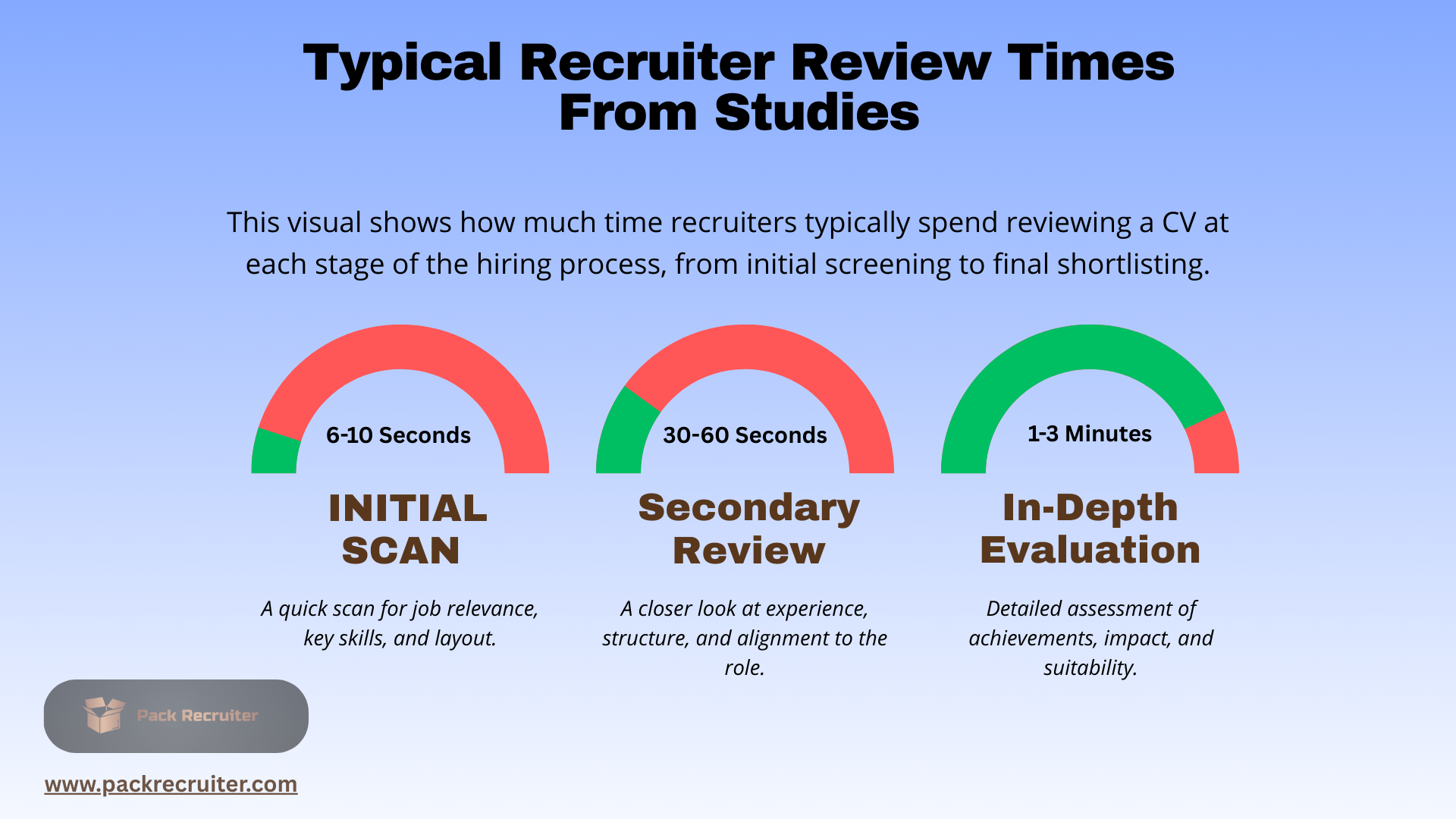
Visual showing how long recruiters and hiring managers typically spend reviewing a CV during the initial screening stage
This funnel highlights why CV formatting, clarity, and relevance are critical. Most CVs are rejected during the initial scan, not because candidates lack experience, but because key information is difficult to find or not immediately aligned to the role.
Recruiters and hiring managers review large volumes of applications daily, meaning they rely on structure, keywords, and clearly presented achievements to make fast decisions. CVs that are well-formatted, easy to scan, and tailored to the job description stand a far greater chance of progressing to interview.
While you can’t control how many applicants apply for a role, you can control how clearly your experience, skills, and results are presented. A strong CV ensures the right information is seen in the limited time you’re given.
7. Avoid Vague Language and Buzzwords
Phrases like “hard-working,” “team player,” or “excellent communicator” say very little about your real ability and are often ignored. Recruiters prefer evidence of skill through actions and impact.
Instead of “I am a great team leader”, try:
Led cross-functional teams to deliver project outcomes 10% under budget.
8. Your CV Is Not a History - It’s a Marketing Asset
Not everything belongs on your CV. Leave out:
Personal details (age, marital status, address)
Irrelevant hobbies
Basic technologies everyone uses (e.g., MS Office) unless advanced
Referees (these are assumed)
Use your cover letter or interview to fill nuance - your CV’s job is to reach that stage.
9. Make a Strong Personal Profile
At the very top of your CV, include a concise Personal Profile:
Who you are
What you specialise in
What value you bring
Keep this to about four lines and tailor it slightly for each role you apply for.
10. Final Advice: Take Time. Be Confident.
Most people cast their CV into the void and hope something sticks. That’s not a strategy. Research shows a corporate job opening can attract an average of 250 applications, and only a small fraction make it to interview.
A targeted, keyword-rich, achievement-focused CV increases your chances dramatically.
Your CV isn’t a chore. It’s your professional highlight reel. Treat it with the care it deserves and give every word a purpose.
Ready to take it further?
If you want personalised CV advice, specific packaging industry tips, or help positioning yourself for a career move in packaging and print, Pack Recruiter is here to help.
Sources and Further Reading
This guide combines over 30 years of hands-on recruitment experience with publicly available research on CV screening and hiring processes.
Psychreg
CV tailoring and the impact of Applicant Tracking Systems (ATS)
https://www.psychreg.org/cv-tailoring-crucial-as-recruiters-use-ats-software/AI Resume Guru
Recruiter CV screening time and resume statistics
https://airesume.guru/blog/resume-statistics-every-job-seeker-should-know-in-2025/Novorésumé
Resume statistics and average application volumes
https://novoresume.co.uk/gb/career-blog/resume-statisticsScout Apply
Resume screening benchmarks and interview conversion rates
https://scoutapply.com/research/resume-checker-benchmarksSource: HR Review / recruiter behaviour stats
https://hrreview.co.uk/hr-news/recruitment/make-your-cv-count-recruiters-decide-in-7-seconds/377194Zippia – Resume statistics & hiring data
https://www.zippia.com/advice/resume-statistics/AIResume Guru – Resume performance & recruiter behaviour
https://airesume.guru/blog/resume-statistics-every-job-seeker-should-know-in-2025/Harvard Business Review – How hiring managers evaluate candidates
Harvard Business Review - Ideas and Advice for LeadersHR Review – Recruiter CV screening time
https://hrreview.co.uk/hr-news/recruitment/make-your-cv-count-recruiters-decide-in-7-seconds/377194Pack Recruiter
https://packrecruiter.com
Would you like an expert opinion on your CV?
Fill out the form below and one of our consultants will get in touch with advice
Follow us on our Socials